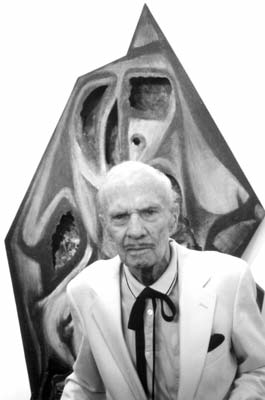
Behind the layers of Tristan Meinecke
“I am an experimentalist,” is how eighty-seven year old artist Tristan Meinecke describes himself. “I have almost always been agnostic but now I draw Christ-like images.”
However, it wouldn’t be right to place his work in an art school or a movement as it is so diverse among the layers of expressionism, surrealism, cubism, and his well-established form called split-level painting. Not only a painter, but also an architect, a professional musician, and a writer, this octogenerian is still dynamic enough to exhibit his work. Tristan Meinecke’s work, from 1935 to 2000, was featured last month at the 1926 exhibition space in a solo show entitled Tristan Meinecke: Heterogeneous Icons.
Despite Meinecke’s extraordinary talent, he is not a huge name in the art world. In the exhibition catalogue, co-curator and SAIC sound professor John Corbett writes, “Almost certainly, Meinecke’s name would mean something different had he left the Midwest.” However, Corbett adds, “Meinecke remains one of the monumental artistic secrets of Chicago, a man whose contribution remains to be adequately understood and evaluated.”
Being eighty-seven, he naturally has some difficulties in remembering dates, but manages to keep his energy through the interview. “I have this carpal tunnel syndrome and I can’t use my hand anymore. I am very shaky; I can’t do painting right now. The last painting I did was in 2000. Now I am a couch potato,” he jokes. Yet, the selections of his paintings, from the ’30s to the present that were featured at 1926 and will be shown in Milwaukee in January, speak to the artist’s strength.
F News: How did you come to curate this exhibition?
John C.: By being moved by a story that was not told in total. I read [Meinecke’s] stories long before I met him; that’s how I knew him first. And his work is so unique; I have never come across with an artist working on split-level form before.
F: And how did you come up with the name Heterogeneous Icons?
J.C: We discussed it with Tristan, although Tristan doesn’t remember this now. We originally [were going to call it] Cantankerous Imagination.
Tristan: Which is because I can be very irritable.
J.C: But with Cantankerous Imagination, the emphasis would be on the person. The idea of the show is the work now. And Heterogeneous Icons is the name of his significant split-level painting, which was exhibited in the American Show at SAIC in 1957. The New Republic, after the show, [described it as] “the only painting in the show that pushes back the frontiers of art.”
F: Could you tell us more about the split-level form?
J.C: One of the innovative aspects of the split-level is it had a solution to a basic problem, which had to do with how you create a sense of depth in a painting without resorting to conventional perspective techniques. How could you have a painting that felt like there was a sense of dimension at least in a cubist way? Split-level introduces literal dimensionality to paintings ... They have a real sense of depth; you can look through it.
T: Split-level started in the ’50s. I threw a hammer to my painting that I didn’t like. Then I put another painting on it, through which I gained a shape and movement. You see the painting, and you see how it moves through looking at its different layers.
F: What would you describe yourself as —a painter, a musician, an architect, or a writer?
T: I had so many talents that I had to
choose. I didn’t like painting, not that much. Painting
is very messy, you know. I liked music and I think music is
a better artwork, too. But [I chose to be] a painter, I guess,
because it takes so much time and it needs practice. I didn’t
like to practice, though; that’s why I never got better,
but I made music at the same time. My dad was a great musician
but he never taught his kids anything [about it]. He tried
to teach us how to play the piano and I remember I didn’t
do it [right]; he got mad and hit me.
F: Did he teach you how to paint?
T: Oh, I remember I drew all the time. I was two and a half and I was lying on the floor, sucking my thumb and drawing.
F: Why did you choose different styles in your paintings?
T: I got bored painting the same painting. I experimented. That is the main thing, because painting exists in space and music exists in time and I got movement by painting. A lot of painters try to get movement in painting and I got movement creating angles. As you move from these angles, you see the painting and it moves.
F: You also work with different materials, such as a tractor cover.
T: Yes, that’s true. One day, in the ’50s, I found a tractor cover along the way and I felt I had to do something with it. I took it home and glued it and colored and gave it a mask shape … it didn’t crack.
F: John, what do you think of curating someone you become close to? I assume that you and Tristan have been really close through this exhibition process.
J.C: There is a prohibition against that as if you should be called an objective person to people you curate. I think you gain something by knowing someone personally and you lose a certain amount of objectivity. That’s why you have other people around you and you use them as an adviser. For me, getting to know the artist is important. I would never review them, on the other hand. … A show in my opinion assumes a certain kind of proximity. If you don’t know the artist well, you miss a certain level of analysis. But some curators I know would prefer to curate at an arm’s length, and not know the artist.
Photography by Startraks Photo