 |
|||
 |
|||
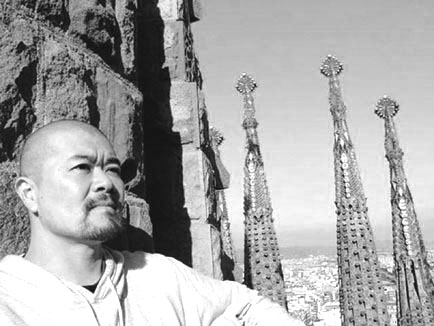
| K.K.
Null talks frankly about musical experimentation and exploration
Robert Becraft: Many of your solo works achieve paroxysms without linear progression or obvert tension-and-release. Is this a conscious decision?K.K. Null: Honestly, your question is a bit too abstract to me. Therefore, I�m not sure exactly what you mean. Basically I don�t have any abstract concepts, a philosophy, or an ideal goal before creating sound or playing music. So, maybe it�s unconscious. RB: Deep, terrene reverb and seemingly celestial drones emanate in your soundscapes. Can this be perceived as an approach towards the realm of metaphysics? KN: If you think so, that�s fine with me. RB: How do you view the trend in ambient music towards quirky, irregular clicks and pitch modulations? KN: I�m not a trend analyst or a music journalist. I don�t exactly know what you mean by �ambient music.� If you can give me a concrete sample, maybe I can give you my opinion. RB: Your highly textural soundscapes souse listeners in a feverish furry, in reverie, and ultimately in self-reflection. Could this be attributed to an empathy-over-understanding kind of aesthetic? KN: Could be... RB: What explains the international recognition and praise of the Japanese musical avant-garde? KN: I don�t know. RB: What distinguishes Japanese noise/experimental artists from Western contemporaries? KN: I have no idea. RB: Do you see different veins of experimental noise/free jazz in Japan? Should bands like Shibusa Shirazu be distinguished from well-known names like Merzbow, Masonna, or Fushitsusha? KN: Yes, I do. I�ve never heard the music of Shibusa Shirazu, but Merzbow, Masonna, and Fushitusha are all different to me. |
|||
|