An SAIC Retrospective
Through the Biased Lens of F News
SAIC is over 100 years old. It is an institution that was founded on the European academic principles of fine arts education. Yet, SAIC feels like a fresh enterprise, like there is no such thing as old news here. Maybe that's because, in the past 20 years or so, SAIC's population has grown exponentially and new programs and degrees are added all the time. All of these factors could contribute to the feeling that SAIC didn't really exist before 2000, when I first began as a student. So I took it upon myself to correct this misguided notion and learn some of the brighter points in SAIC's colorful history. Three Most Controversial Student Art Pieces
"Diversity" Will Always Spin Like a Broken Record
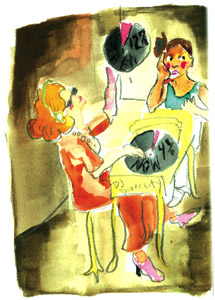
Calling this a Year of Diversity, [Dean of Faculty Carol] Becker stated the administration's goal to address the issues of cultural difference at SAIC and bring them out onto the table.
-- From "New SAIC Building to Open in Spring" by Rebecca Franke, F News, Oct. '99
Down significantly from the seventies, African-American students, who used to represent 12.3 percent of the student body, now comprise only 4.8 percent. The first question I ask is why this has happened. The biggest reason is the cutbacks in financial aid most minority students depend on. However, some of my friends who are former students have another story. They say they cannot recommend SAIC with a clear conscience. One person told me that SAIC was not hostile, but it failed to be conducive to creativity and the encouragement of young artists. Most importantly, from alumni I spoke to, the insightful comment was that students identified the hollow talk of diversity without its real presence in the classroom -- or even the administration for that matter.
-- From "The Power Within Us Building Community at SAIC" by Marie Cochran, F News, Oct. '92
As far as I am concerned, multi-cultural affairs is a part of the SAIC community. Whether people want to realize that is the issue. By virtue of the fact that we are here, we are a part of the SAIC community. We need to dispel the myth that exists that we are separate. There may be people who view us as separate, and if that is the case, that is something we have to work on collectively to make sure that everyone realizes that we are a part of their community and not a separate entity at SAIC.
-- Maryam Assam, as quoted by Asante Salaam in "SAIC's New Dean of Multi-Cultural Affairs," F News, Sept. '91
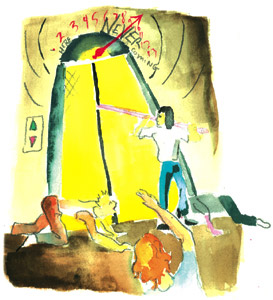
Elevators Will Always Suck and Provide Opportunity for Eavesdropping
Any building with elevators has elevator problems, and the Champlain Building is no exception. They have been known to do erratic things rather than the routine simple up-and-down. Although the electronic controllers act confused at times, they are safe! The elevators are equipped with safeties that prevent "free fall" and also prevent the elevators from going above or below normal operating ranges. It is impossible for one of our elevators to crash, but they can get confused as they seek the specific floor. This confusion seems to increase as the electronic controls accumulate dust. Heat and humidity also seem to affect the controls. New brakes have been installed on all passenger elevators during the summer as routine maintenance. Since the controllers have also been rebuilt, the erratic trips have greatly diminished.
-- From "The Inside Story on the Champlain Elevators" by Ross Gonikowski, F News, Oct. '90
"So, I needed a dildo for some film assignment. And I had to go to one of those, you know, sex shops."
"Really, how funny."
"Yeah, so anyway, I had never been in one of those, it was really crazy."
"I'm sure."
"The funny part is that they wouldn't accept checks, so it's going to show up on my credit card."
(uneasy laughter)
--From "Overheard on 112 S. Michigan Elevator" (no byline), F News, Nov. '94

People Will Always Say, "That's Interesting" During Critiques
Here is a small list of phrases taken from real critiques I have been to and that I have heard innumerable times:
- I think it is very nice.
- There is an interesting dialogue between the shapes.
- It's very powerful.
- It's very successful.
- It sort of gives me a feminine feeling. (When the work is, of course, by a woman.)
- I like the use of negative space.
- I like the simplification.
- I like the use of bold colors.
- It's very organic.
- It seems like a stage to me.
- It has a narrative quality.
- I think the spatial relationships are quite interesting.
- It looks like you took some risks with it.
- It's playful and kind of funny.
- Reminds me of Philip Guston (or any other trendy artist).
- It looks very sexual to me.
- I like the balance, sort of a yin-yang feeling.
- I like the use of warm and cool colors.
- It makes me think of the femme fatale sort of idea.
- It is real convincing.
- It is so intimate, it's very personal work.
-- From "The Impalpable Critique" by Pablo Helguera, F News, Dec. '91
A Look Back at WW II-Era SAIC
John McGuire attended SAIC from 1956-1959, finished his degree at Michigan State University in 1961, and ...is now a staff writer for the St. Louis Post-Dispatch ... "There were really two categories of students at the school. Korean War Veterans there on the GI bill. They were frighteningly serious students. Many of the Vets [sic] were there for industrial design. The second group seemed to be made up of Chicago-area kids who were the best from the area high schools. I remember my life drawing class with Mr. Landers, he had me draw eggs over and over; I suppose I was lagging behind." ... "I had a design class on the upper floors of the museum, it really seemed like an attic with skylights and a construction walkway. At the time, the only entrance to the school was also the main entrance to the museum, and you entered with all the tourists and the pilgrims. Guards were constantly checking us, we banged around the museum with all our folders and our paint boxes, it was a big security problem. The museum officials were worried about what we looked like, and it caused a great deal of friction. They didn't want to shock some woman with her garden society from Cedar Rapids, Iowa, there to see Monets."
-- From "Matt Interviews His Dad: Alumnus Discusses SAIC in the 50's" by Matthew McGuire, F News, Feb. '90
I talked with Norman Marcussen about his experience at SAIC following World War II. A Chicago-based artist, Marcussen also teaches art courses at Lane Tech and operates his own studio. He attended SAIC between 1947 and 1954. His tuition, paid for by the GI bill, was about a thousand dollars a year. He received $65 dollars a month allowance to live on. "I was living in a small room on Superior, near Michigan Avenue, where I paid five bucks a week. So in order to make ends meet I worked in the school store to get my supplies at a reduced rate, and occasionally I would paint signs for supermarket windows" ... I asked Mr. Marcussen if he felt there was then, as there is now, a lack of communication between students and faculty and also, if he or any of his fellow students had feelings of alienation. "Hell no, we always knew that if we needed it, help was there on any matter -- be it from a member of the faculty or a fellow student. There was a feeling of camaraderie between us. When you were going to the Art Institute, it felt like you were a member of the family. It was a family of characters and individuals that other people may not understand, but we understood each other. It was a nice feeling."
-- From "SAIC -- 40 Years Back" by Kelly Rickert, F News, March '85
F 's Positive Role in the School Community
First I must rag about the name of this paper. Everyone knows "F" stands for fuck. Who are you kidding? Quit trying to justify naming the school paper fuck by saying that "F" stands for fine arts, forum, and friendship, or whatever else you said. With this thinking, "F" can also stand for fart, fever, farm animals, fantod, fake, fungus, fathead, and fleas, all of which are not too desirable. ... All I know is that a paper named "F" sucks, a lot.
-- Letter to the editor, name withheld, F News. Nov. '87
You guys are a bunch of wus-asses with no tack [sic] or any sort of taste for what is good. Trees have died for your little piece of wet wipe for the artfuck, big pants, stupid hair, big mouth, no brain plebeians that make up a better part of the student population at the Art Institute. But you probably don't have time to mourn for wasted material. You're no doubt sitting in your office, chuckling at the amount of witty banter you've dredged up for the next stinking installment of your rag. Please stop, for the love of Christ. You can't write. You can't edit. You can't design. You can't even fucking spell! Grow up and get a real job.
-- Letter to the editor, by Anna Sutherland, F News, Oct '94
Hugh Hefner on SAIC
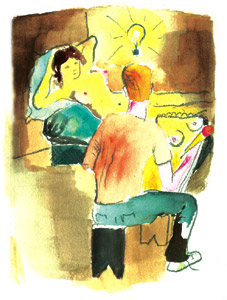
He said that after he was discharged from the army after World War II he spent a semester at SAIC enrolled in a figure drawing class. He spoke of how much he enjoyed artistically working with nude figures and wanted others to be able to share this experience.
-- From "Hefner Visits Our Place" by Cathi Hay, F News, Oct '85
A Word from Tony Jones
Tony Jones on the school community: The idea that anyone would think of art students as being gentle flowers growing in a green house is way off-base. They are heat-seeking missiles. From The Chicago Tribune magazine section Jan 27, 1991. An F writer responded: I would rather be a flower than a missile, especially in this time of a sickeningly American war against not only Hussein, but also the American people themselves.
-- From "Opinion: A Response to the Chicago Tribune Magazine featuring Tony Jones" by Elin Slavick, F News, March '91
Three Most Controversial Student Art Pieces
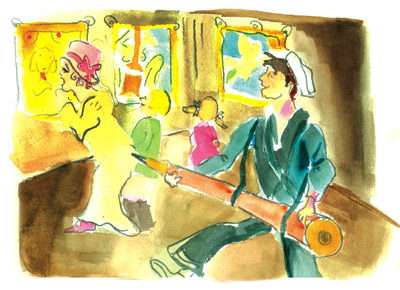
1. "What is the Proper Way to Display the U.S. Flag?" by Scott Tyler
This installation forced people to step on the American flag in order to write in the artist's comment book. This caused many public relations headaches for the museum and the administration.
2. "Mirth and Girth" by David Nelson
This not particularly well-executed painting depicted the late Harold Washington, the first African-American mayor of Chicago, in women's lingerie. Chicago aldermen stormed the president's office in response, sparking a debate about racism on campus, and the museum responded by placing ads in local newspapers promoting their Minority Task Force.
3. The photo series "Mounting Objects," "Stimulating Objects," and "Penetrating Objects" by Aimee Beaubien
The photo series, which was removed from the photo displays in the Columbus Drive building after concerns from SAIC administration, depicted a woman using household objects, tools, and weapons for masturbation purposes.
Illustrations by Padraig Johnston