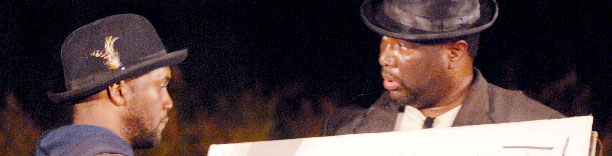
photo by Donn Young, courtesy of Creative Time
Waiting for Godot in New Orleans
SAIC alum Paul Chan stages the Beckett hit in the flood aftermath
NEW ORLEANS — When New York-based Paul Chan first visited New Orleans in November 2006, a year after Hurricane Katrina, he found himself standing at an intersection in the Lower Ninth ward. There, inspiration to stage Waiting for Godot struck him: "I realized it didn't look like a movie set, but the stage for a play I had seen many times. It was unmistakable. The empty road. The bare tree leaning precariously to one side with just enough leaves to make it respectable. The silence. What's more, there was a terrible symmetry between the reality of New Orleans post-Katrina and the essence of this play, which expresses in stark eloquence the cruel and funny things people do while they wait: for help, for food, for hope," he wrote in an artist's statement.
So began a grassroots effort to stage Waiting for Godot in New Orleans, culminating in three performances at that intersection. They occurred November 2 to 4, and were followed by two performances the next weekend on the front porch of an uninhabited home in the Gentilly neighborhood. Waiting for Godot, written by Irish playwright Samuel Beckett in 1949 in the shadow of the Second World War, tells the story of two men waiting on a road for a man named Godot.
Chan, an SAIC alum, teamed up with The Classical Theater of Harlem, which had staged a post-Katrina interpretation of Waiting for Godot in New York in 2006. That stage included a submerged house, and the cast performed atop a several thousand-gallon tank of water. Actors Wendell Pierce, born and raised in New Orleans, and J. Kyle Manzay returned to their central roles for the New Orleans production. Christopher McElroen, co-founder of the Classical Theater of Harlem and director of the 2006 New York-based production, traveled to New Orleans to direct the performances, with Chan as artistic director. Creative Time, a New York-based arts organization, was brought on board. SAIC alum Nato Thompson was the project's curator.
The production faced skepticism from different corners. Some local residents were resistant to outsiders using their neighborhood as a stage set, others were uncertain whether a play staged in the Lower Ninth ward, notorious for crime prior to the Hurricane, could attract a significant crowd. From the outset, Chan was aware of the pitfalls artists could face when traveling to places in turmoil to create work. As a result, Paul Chan, the Classical Theater of Harlem and Creative Time all became involved in the communities affected by the Hurricane. Chan spent significant time gaining the trust, assistance and enthusiasm of local residents and non-profit organizations. Prior to the performances, there were potluck dinners with local residents allowing those behind the project to understand and address the concerns and wishes of the communities. Non-profits such as Common Ground became involved, providing assistance and volunteers for the production. Two of the five actors were cast in New Orleans, and technical crews were hired locally.
There were also workshops at local schools. At John McDonogh High School—one of the first public schools to reopen after Hurricane Katrina, and now part of the Recovery School District overseen by the State of Louisiana—had the actors in conversation with students about practical ways in which students could take positive action toward preserving their culture, pursing careers in the arts, and improving funding for their school.
Promotion for the show was conducted in a similarly grassroots manner. Posters appeared around the city, with text that simply quoted Beckett's introduction to the play, "A country road. A tree. Evening." In some neighborhoods the signs blended with the improvised advertising of local companies or community events. In others, the stark black and white homemade signs mirrored homemade temporary street signs. A local PR firm, Creative Industries, called local organizations to which the play was relevant and asked them: "What are you waiting for?"
The result was a series of performances that brought people together in celebration. Lines around the block in the Lower Ninth ward included locals, New York art scenesters, students and tourists.
The performances were at once poignant, beautiful, unusual and rather surprising. Each evening began with a gumbo reception, after which a local second line band led audience members, some dancing, up the street to their seats. The locations became an integral aspect of the play, both visually and contextually.
The locations and the script have been deemed sacred by some, yet the pairing of the two brought new interpretations to both. At certain points, Beckett's lines resonated particularly strongly: a line in which Estragon, one of the two men "waiting," yells "What is there to recognize?" developed a new level of meaning when the actor was standing in an overgrown field where houses stood two years ago. What was perhaps more important than this reinterpretation was the response it drew from the audience—at that moment, a diverse group of people were comfortable with respectfully laughing. They were intimate with the reality the line highlighted.
The Gentilly site had a different dynamic. While the intersection in the Ninth ward remains overgrown and unpopulated, the stage for the Gentilly performance was the front porch of an uninhabited home. As the project developed, so too did the neighborhood, further involving local residents in preparations for the play.
In addition to the community events that surrounded the play, a fund has been created which will go directly to the neighborhoods in which the play was staged. Also, a film is in the works, and Creative Time will publish a book, *Waiting: a New Orleans Reader*.