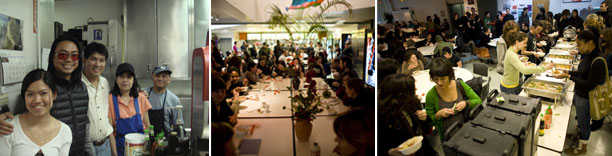
photos by: Nora Taylor (left) and Danny Hsu (center and right)
A review of Rirkrit Tiravanija's Thai food workshop at SAIC
Relational aesthetics at Sonny's
It has been said that art lovers are sensualists, so what art lover wouldn't enjoy the multi-sensation experience that is a Rirkrit Tiravanija work? The artist recently performed— if that is the word— one of his pieces at Sonny's, a cafeteria in the School of the Art Institute's Columbus Building. All senses were engaged in this crowd of students, faculty and Art Institute of Chicago staff.
This was his piece: There were vats of at least three different curry served buffet-style near the kitchen. Then for about a three-hour period, at least one hundred people ate the curry from disposable plates in the dimly lit second-floor room. Tiravanija and his guests walked around and socialized. A film crew interviewed some of the attendants, and random photographs were taken. And that was the piece.
Really, that was it. For those who might scoff about whether such an event is art, we hear you. In the realm of relational aesthetics, however, Tiravanija's work more than succeeds. Relational aesthetics is a theory that emerged in the mid-1990s in which artworks are evaluated based on the human relations they prompt or represent. Between the gut-busting spices and touchy-feely proximity of at least one hundred art-school folks in one room, it is difficult to argue the experience wasn't a teasingly sensual event— and therefore appealing on some level to those who participated. Tiravanija's work, especially in this form, is relational aesthetics at its purest. I talked to a new classmate, caught up with old friends, and a former teacher spontaneously hugged me.
Tiravanija's oeuvre includes a host of works that question the use of spaces, especially those of art institutions. While serving food in a cafeteria is not as risky as some of his other works, which have at times involved potentially anarchic semi-public spaces, the School of the Art Institute of Chicago was fitting. Tiravanija attended the school as an art student, and this was his chance to come back and have the Dean and faculty celebrate— even fawn over— him. The community has recently begun to address the question of its cohesiveness by asking students how they would make SAIC a more welcoming and accessible place. Whether administration planned it or not, Tiravanija's piece was another way to explore and develop a deeper sense of community at the School.
However, one wonders if the placement of the piece was selected because of liability issues. Would it not be more interesting to serve food in the school's famously crowded elevators? Or in a classroom? How would a spontaneous setting affect student's sense of obligation to teachers and their yearning for free home-cooked meals? The safe setting of the cafeteria toned down any questions the work might have raised (such as why here? Why now?), thus diluting its quality. There was a dulled, retrospective feel to the event: Tiravanija's Pad Thai works are the stuff of the 1990s— Tiravanija has moved on artistically, so this project felt nostalgic and perhaps a little forced.
Perhaps it is the "event" aspect that makes it art. Or maybe it is the fact that a celebrated School alum is now asking the community to take some time out from the whole art-making business to eat spicy food and socialize. The prospect of such an invitation by an art-world darling is too much for any student to turn down— especially for the sensualists.