
Chronicling
Love
by Gregory Forsyth
Charles Baxter's fourth novel, The Feast of Love, is at
once a hilarious and sad portrait of life and love in the new millennium.
The book takes place in Ann Arbor, Michigan, and begins with Baxter himself
plagued by a nightmare that urges him out of bed and into the night for
a contemplative stroll. Stopping to rest at a park bench, he is joined
by a familiar acquaintance, coffee shop owner Bradley Smith, who, incidentally,
becomes one of the novel's main characters. While discussing ideas for
Baxter's next book, Bradley suggests the following: "You should call
it The Feast of Love. I'm the expert on that ... I'm an expert on love.
I've just broken up with my second wife, after all. I'm in an emotional
tangle. Maybe I'd shoot myself before the final chapter. Your readers
would wonder about the outcome."
Bradley further suggests sending people to
Baxter, people like himself who have struggled to find love, struggled
to live with and without it. If entry into this novel is slightly disorienting
(given the author's choice to become a character in his own fiction),
Baxter quickly brings Bradley Smith and friends into the foreground as
narrators. The people Bradley sends to Baxter are a diverse cast. Chloé
and Oscar are two youngpunks who work for Bradley in the coffee shop.
Kathryn and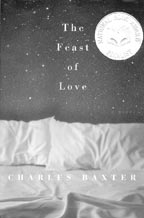 Diana are Bradley's ex-wives. Kathryn falls in love with a woman, while
Diana falls for a married man. A Kierkegaard scholar living next door
to Bradley struggles to connect with his mentally ill son.
Diana are Bradley's ex-wives. Kathryn falls in love with a woman, while
Diana falls for a married man. A Kierkegaard scholar living next door
to Bradley struggles to connect with his mentally ill son.
As new characters are introduced, they earn
the right to inhabit their own chapters. Versions of events are corrected
or confirmed depending on who's giving testimony, and Baxter is careful
to give each character a unique voice, one consistent with age and background.
He is more successful with some characters than others. For instance,
Chloé, the streetwise, cheeseburger-scarfing punkette, whose voice
dominates the novel's second half, wanders, at times, too far from her
immature scatteredness to come off as fully believable. One moment she
says, "I'm on, like, the bottom of the socioeconomic scale, as they
call it. I can't do the money thing," and the next, "I know
it's audacious for Oscar to say he was going to be resurrected. But why
shouldn't he be? Resurrection is a form of recycling. There's an efficiency
to the cosmos." Baxter takes great care with his Chloé character,
endowing her with the perfect mixture of street wisdom and naiveté,
but there are too many occasions where this mixture is threatened, as
when she is uses words like "mellifluous" in her everyday conversation.
However, it is a small and forgivable flaw, and while Chloé steps
out of character once or twice too often, ultimately, the reader is glad
that she wasn't dumbed down, but rather made unusually intelligent.
And it's the intelligence of Baxter's characters
that is best used to chronicle love - the angry kind, the abusive kind,
the sex-starved, the unrequited, and the kind that buoys us when everything
else has sunk. In the end, The Feast of Love captures many truths about
how we live and love one another. While there may not be much more to
learn about the theme of love, there is pleasure in the familiarity of
the subject and the beauty of Baxter's writing. Simply put, we are able
to see ourselves reflected in these pages.
The Feast of Love was a finalist for the 2000
National Book Award. Other works by Charles Baxter include Believers,
Harmony of the World, A Relative Stranger, and Through the Safety Net.
| more reviews.. |