
First
Sightings
by Shannon Galvin
Breaking into Print: Early Stories and Insights into Getting
Published is neither just a short story anthology nor a typical how-to
book. It's a wonderful amalgamation of different forms in a single body.
In this collection, editor DeWitt Henry (co-founder of Ploughshares literary
magazine) anthologizes the first stories of famous and respected writers
who appeared in Ploughshares early in their careers. Tim O'Brien, Sue
Miller, Mona Simpson, Gina Berriault, and Janet Desaulniers, an instructor
in SAIC's MFA writing program, are among those whose work is included.
Preceding each story is a glimpse of the early
publication history of the author and how publication in Ploughshares
affected their careers. Desaulniers' network of contacts expanded with
the receipt of letters from agents, editors, readers and other writers.
"They took the time to write to an uneven apprentice. I learned things
from those letters." Miller supported this, adding, "I've always
told other young writers, there are a lot of people out there reading
[literary] magazines, people who care about fiction enormously, so that
even though the circulation may not be as high as some more commercial
magazines, the readership may be very important."
Many literary magazines are connected to established
universities and liberal arts colleges whose instructors and professors
either edit or serve on their advisory boards. Although Ploughshares'
first home operated out of Henry's apartment 30 years ago, Emerson University
has supported the literary magazine since 1988. A list of respected literary
magazines and their addresses is offered in one of Breaking into Print's
appendices. 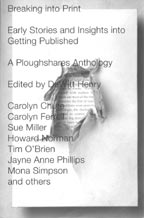
The authors and Henry agree that tenacity and
durability are the overriding factors to success in the publishing world.
More than one author revealed how a story was rescued from the slush pile
after an initialdismissal. Quoting Theodore Solotaroff's 1985 essay, "Writing
in the Cold," Henry looks at the way that writers deal with "uncertainty,
rejection, and disappointment from within as well as from without ...
How effectively one incorporates them into the creative process itself"
is essential in dealing with the isolated and lonely career of being a
writer. Henry recognizes that many talented writers are overlooked, yet
remain dedicated to their art: "Keeping and fully realizing talent's
promise - growing as a writer - is as much a personal as it is a cultural
feat, depending on both persistence and luck in dilatory time."
Throughout Breaking into Print, Henry instills
hope in those who have yet to be published. Miller was 42 years old when
her first novel The Good Mother appeared, and 35 years old when she first
began to write. Both The Good Mother and Inventing the Abbotts were adapted
into movies. Many of the stories included in this collection were also
prize winners and/or included in other anthologies like Best American
Short Stories and The Pushcart Prize, the best of America's small presses.
At the end of the collection, Henry includes
appendices undoubtedly useful to the novice: lists of resources for writers
including books on editing and publishing, handbooks on craft, websites
for writers, and general advice to writers hoping to submit their work
for publication. Breaking into Print is a useful collection because it
offers advice but also provides anecdotes and original work. Readers can
learn directly from the source, deconstructing the prose and asking the
questions: Why is this work successful? Why did the editor choose this
story? The answers are ones any aspiring writer needs to figure out.
| reviews page1.. |