
Mar29th
Piotr Wyrzykowski
SAIC Auditorium
Piotr Wyrzykowski (a.k.a. Piotr Style), a technology
and club artist from Poland, opened the Visiting Artist Program lecture
series, The Art of Club. One of the founding members of the Technical
Culture Central Office (C.U.K.T), a collective that has been exploring
the co-existence of computers and human beings, Wyrzykowski has worked
with non-art audiences and public sites since 1994.
Wyrzykowski displayed the group's manifesto and
declaration, as well as several examples of their work. Recurrent themes
were human responses to robotic or bureaucratic situations and the use
of public spaces, such as clubs or the Internet, to carry out projects.
Wyrzykowski referred a number of times to the concept of human vs. cyborg,
the fusion of human and machine.
The group's most recent project was a series of
club events in which they set up checkpoints and little tests that attendees
had to go through in order to get to the dance floor. According to Wyrzykowski,
they were using the tests to identify cyborgs. Anyone who refused the
test was a person, which is an interesting reversal on the test/success
idea. He said this project was not specifically about communism and bureaucracy,
but about bureaucracy everywhere, including bureaucracy in art.
In 1995, C.U.K.T. opened a club in an old Napoleonic
fortress. In this space, C.U.K.T. hosted an anti-election technodemonstration,
in which they promoted a fictitious candidate publicly, then held a mock
election inside the club. First, they sent ballots to people and asked
them to use the alternative ballot instead of the official one. The only
candidate on the ballot was Nikolai, a persona used by one of the members.
When Wyrzykowski showed an image of the ballot with the one candidate
on the screen, the audience laughed and he laughed too, adding that, "[it]
is not really funny because the last 50 years in Poland, elections were
that way." C.U.K.T. then set up voting booths in the club with clear
walls so everything the voter was doing was completely visible. If that
wasn't enough, they also installed cameras above each booth. (This project
is on view at the Chicago Cultural Center through May, as part of In:
Between: Art from Poland, 1945-2000.) 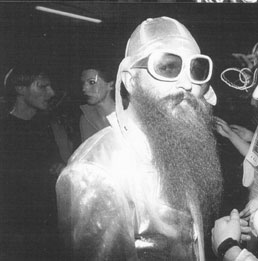
C.U.K.T. is also interested in bringing a non-art
audience into a public space with art installations or artistic context
to see what will happen. He described the eclectic club audience�skinheads,
drug dealers, car thieves�in the fortress club, which is very different
from the usual art gallery audience.
For one of their first projects, Wyrzykowski and
his colleagues set up a club space with art exhibits in a small Polish
town. This town didn't have any organized public gathering places, so
they wanted to establish a club/art gallery space, let the citizens of
the town bring their own music, and see what would happen. Unfortunately,
they had to close after seven days because the DJs were being threatened
by gangsters: "Play this music or you'll be taken in a car to the
woods." The citizens of the town were so angry that the club closed
they burned the gallery. For Wyrzykowski this was a successful result
because he was more interested in the reaction to the space than any kind
of reaction to the art displayed in the space.
The C.U.K.T. website (http://cukt.art.pl)
contains the group's manifesto and limited examples of their work. A new
site with full documentation of their projects is under construction and
should be available soon.
| more on page3 | back to page1 |