
Apr2nd
Renata Stih and Frieder Schnock
SAIC Auditorium
"Our lives are not for sitting in an ivory tower
and thinking "Oh God I am a genius," said Renata Stih. "It's
boring to sit in your studio all day." Stih and her collaborator,
Dr. Frieder Schnock, do the very opposite. They have worked together on
several large public art projects in Berlin that deal with social and
political issues, some of which they described at a recent joint lecture,
where they also spoke of Berlin as a place for making art. "It is
important to bring art out of the narrow clique of art people and bring
it out to daily life," Stih said.
Asked who the intended audience was for their
work, Stih replied, "I think it is for everybody who is interested.
I don't have art racism. Everybody is as interesting as everyone else."
She is as interested in the opinion of her butcher as of a well-known
art critic.
The very public nature of their projects testifies
to Stih's populism, though it can also bring unexpected incidents. When
their Places of Remembrance (1992/93) was first installed in the Bayerische
Viertel neighborhood in Berlin, it was removed by police officers at the
request of offended locals, who complained about anti-Semitic propaganda.
Ironically, the installation was intended as a memorial to the Jews that
had lived there until they were deported during WWII (among them was Albert
Einstein). Stih and Schnock rewrote Nazi laws from 1933-45, printed them
on eighty 60 x 70 cm aluminum signs along with a corresponding image,
and placed them around the neighborhood. One sign showed a red park bench
on one side and on the other side read, "At Bayerischen Platz, Jews
may sit only on yellow park benches."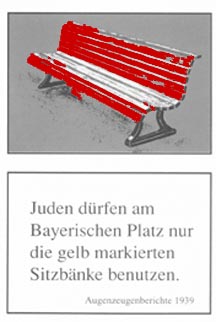 The work was reinstalled four days after its removal, and has remained
there ever since, along with the addition of explanatory plaques requested
by the public.
The work was reinstalled four days after its removal, and has remained
there ever since, along with the addition of explanatory plaques requested
by the public.
Schnock, with a Ph.D. in Land Art, is also an
art historian; Stih lectures at the University of Applied Sciences in
Berlin. Referencing her early, more traditional artmaking days, she recounted,
"We are staying in the 162 N. State St. building. I went up to the
studio on the 17th floor and I saw all the paintings everywhere and thought
it looked like my old studio from the academy. I expect students to throw
stones at society. That's what artists should do."
| back to what you missed | page2 | page1 |